
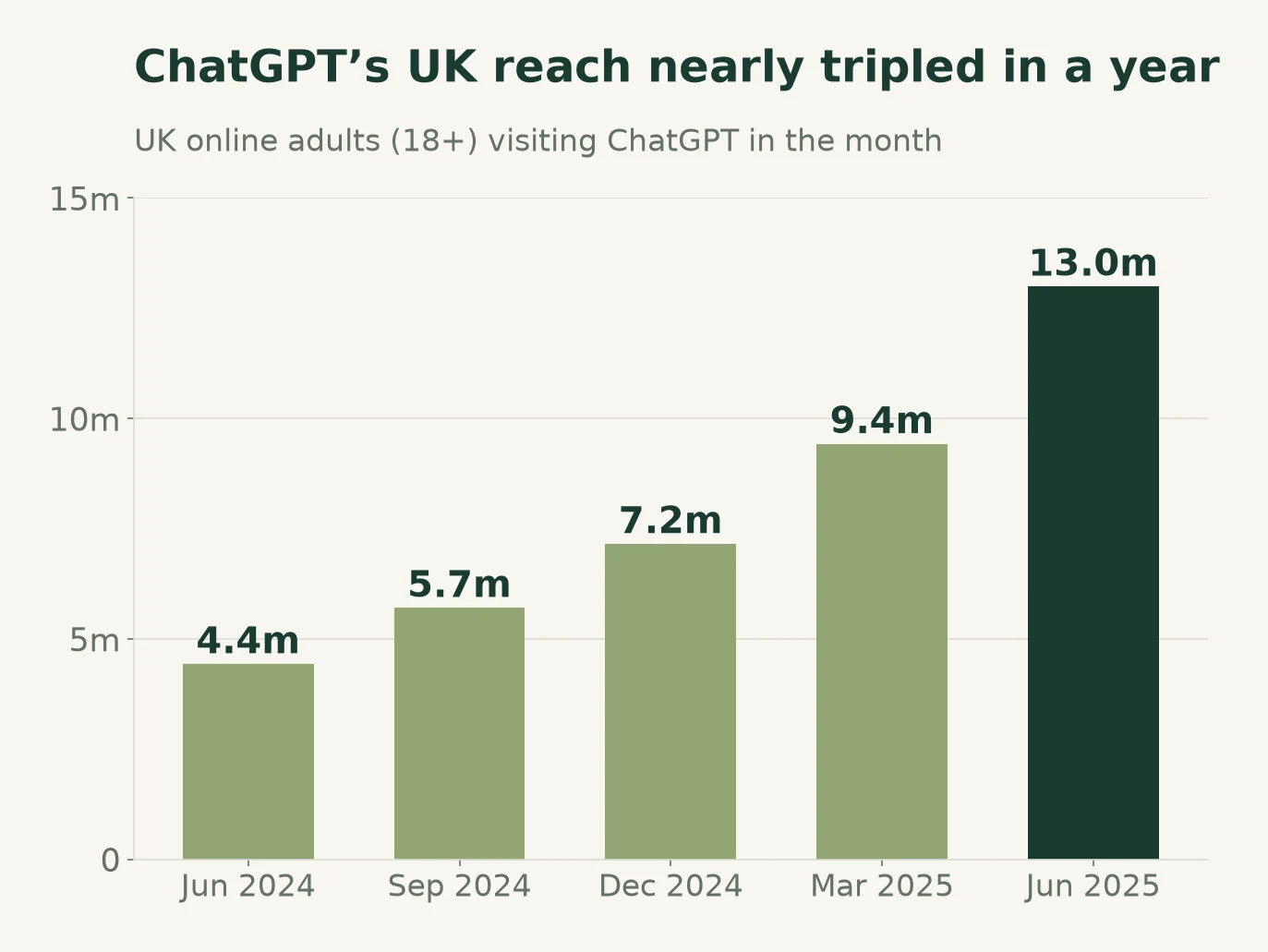
- AI assistants are now a real research step for UK shoppers. ChatGPT reached 13.0 million UK online adults in June 2025.
- In the UK you cannot yet buy inside ChatGPT, Google AI Mode, Copilot or Perplexity. Assistants send shoppers to your site to buy.
- Assistants choose products from crawlable pages, feeds and reviews. Complete, consistent product data matters more than any trick.
- Google needs no special AI markup. Merchant Center, accurate structured data and normal SEO do the work.
- Measure AI referrals in GA4, track a monthly prompt panel and fix data gaps at their source.
Why AI shopping matters for UK retailers now
Picture a customer who opens ChatGPT and types: “I need waterproof trail running shoes for muddy winter runs. Men’s size 9, wide fit, under £130 and delivered to Manchester by Saturday.” A few years ago that search would have been split across Google, a few retailer sites and a review forum. Now an assistant can turn it into a shortlist, compare the options side by side and send the shopper to a product page that is ready to buy.
Whether your product makes that shortlist depends less on clever wording and more on whether your product information is complete, consistent and easy for a machine to read. This guide explains what is actually live in the UK in November 2026, how the main assistants choose products, and the practical steps a UK retailer on Magento 2, Shopify or WooCommerce can take now.
The audience is already large. Ofcom’s analysis of Ipsos iris data found that 15.8 million UK online adults (32%) visited at least one AI chatbot in June 2025, and ChatGPT alone reached 13.0 million (26%). That is almost three times its reach in June 2024. Ofcom’s Online Nation 2025 report adds that ChatGPT had 1.8 billion UK visits in the first eight months of 2025, compared with 368 million in the same period of 2024. Google is still the most-used search service, reaching 82% of UK online adults, but ChatGPT is now the clear leader among AI tools.
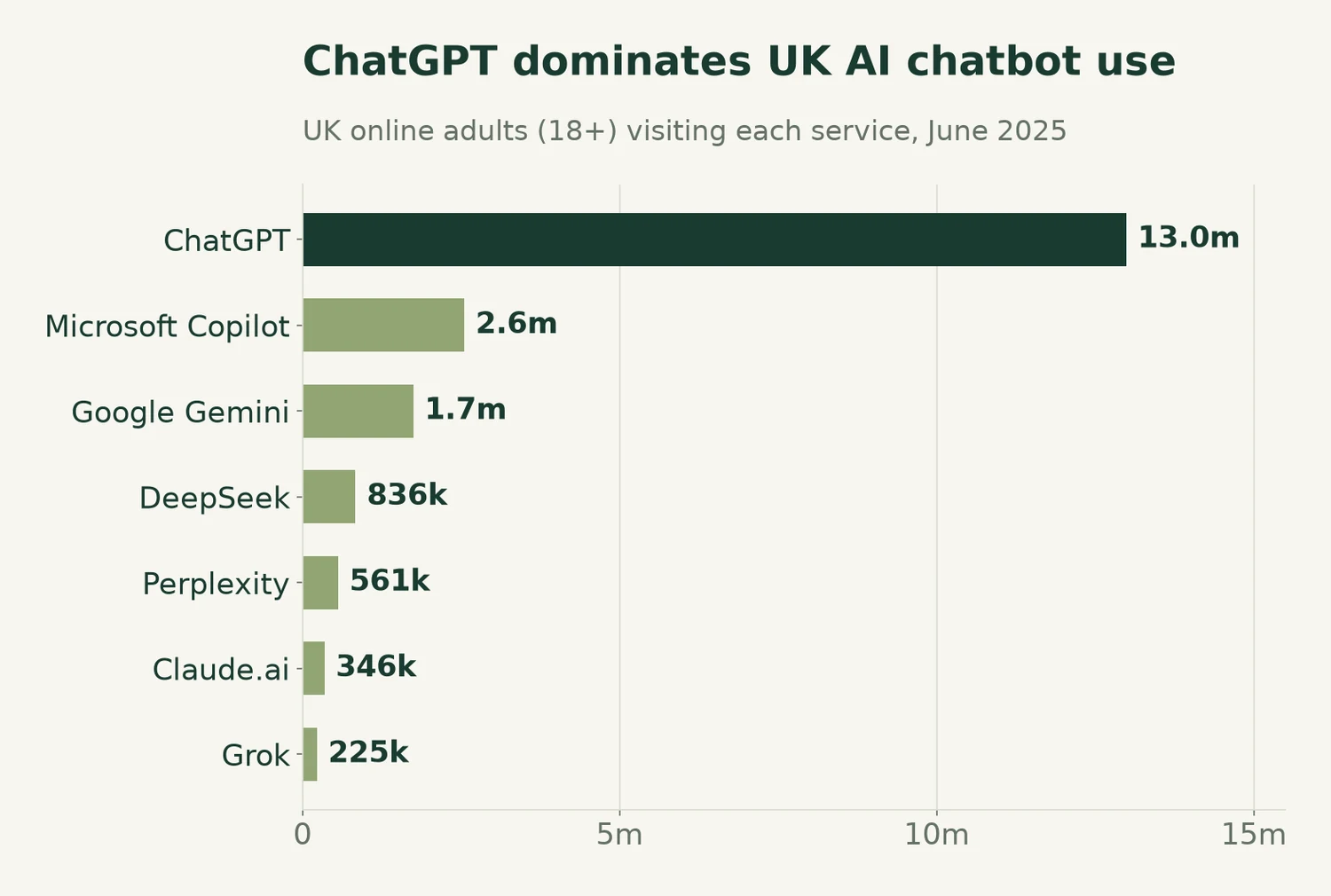
Shoppers are using these tools to buy, not just to chat. Adobe Digital Insights reported that traffic from AI sources to UK retail sites grew 329% year on year over the 2025 Christmas period, with Boxing Day up 685%. Adobe is careful to add that the overall numbers are “still relatively small”. Barclays found that 12% of UK adults had used AI tools to compare prices and deals, and 11% to help with product research.
Keep the scale in proportion. BCG’s analysis of leading European brands and retailers found that traffic referred by AI assistants was still under 1% of site visits in late 2025, although it expects that share to reach 3–5% within a year. BCG also argues that the indirect effect is bigger than the clicks: more of the research now happens inside the assistant, and only the last steps happen on your site. For most UK retailers, AI shopping is not yet a large sales channel. It is a fast-growing research layer that sits in front of your existing channels.
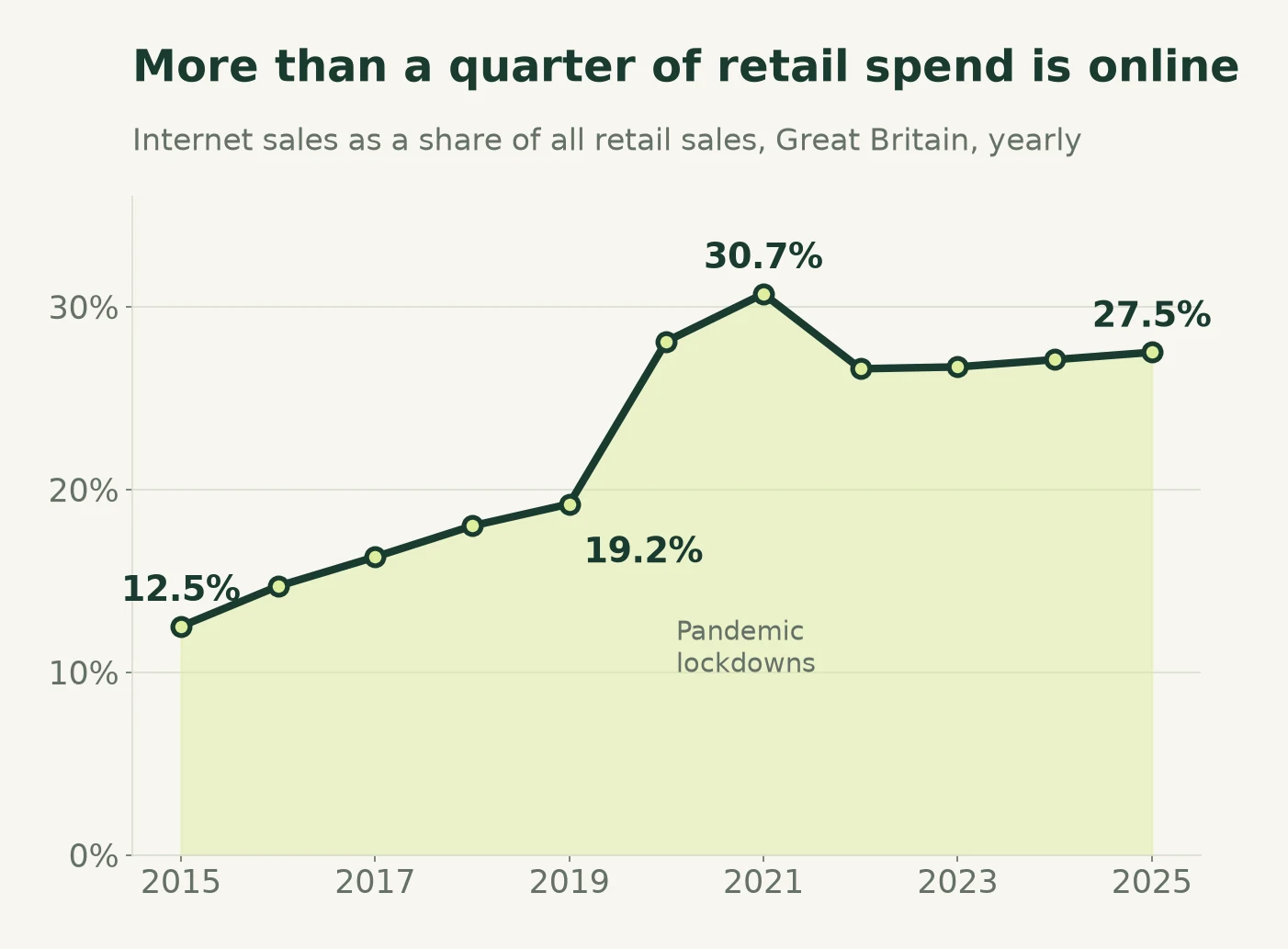
Online retail itself is steady rather than booming. The ONS puts internet sales at 27.5% of Great Britain’s retail sales in 2025 and 28.3% in September 2026. Adobe recorded a record £118.5 billion spent online in the UK in 2025, up 2.8%. When the overall market grows slowly, the retailers who win are often the ones who are easiest to find and easiest to buy from. AI assistants are becoming part of that.
What each AI shopping assistant can do in the UK
Much of the coverage of “agentic commerce” describes features that only work in the United States. Here is what UK shoppers and UK retailers can actually use as of November 2026.
| Assistant | Product discovery for UK shoppers | Buying inside the assistant | What a UK retailer controls |
|---|---|---|---|
| ChatGPT | Yes | No. Shoppers complete the purchase on the retailer’s own site | Crawlable pages, product data quality, Shopify Catalog (if you sell to the US), Business Hub profile |
| Google AI Mode and AI Overviews | Yes (AI Mode since July 2025) | Not yet. UCP checkout is limited to the US, Canada and Australia, and Google says the UK comes “later” | Google Merchant Center, structured data, normal SEO |
| Microsoft Copilot | Yes | No. Copilot Checkout launched in the US | Microsoft Merchant Center feeds, Bing indexing |
| Perplexity | Yes | No. Instant Buy with PayPal launched for US users | Crawlable pages, merchant programme |
ChatGPT: discovery first, checkout on your site
In March 2026 OpenAI launched richer shopping results in ChatGPT for Free, Go, Plus and Pro users: visual product browsing, side-by-side comparisons with price, reviews and features, and conversational refining. It also extended its Agentic Commerce Protocol (ACP), an open standard maintained by OpenAI and Stripe, so that merchants can share product feeds and promotions for discovery.
The bigger change was to checkout. Instant Checkout launched in September 2025 for US users buying from US Etsy sellers. Six months later OpenAI said the first version “did not offer the level of flexibility that we aspire to provide” and began letting merchants use their own checkouts while it focused on product discovery. In practice, ChatGPT is a research and referral channel. The sale happens on your website, so your product page, basket and checkout still have to close it.
There are three routes into ChatGPT’s product results, and they matter differently for UK retailers:
- Web crawling. ChatGPT search uses the
OAI-SearchBotcrawler. OpenAI says sites that block OAI-SearchBot will not be shown in ChatGPT search answers. This is the route every UK retailer can use today. - Shopify Catalog. OpenAI says Shopify merchants’ product data is integrated through Shopify Catalog with no extra work. Shopify’s help centre adds a condition: the ChatGPT channel requires your store to sell to customers in the United States, although the store can be based elsewhere.
- Direct product feeds. Businesses can claim a profile in ChatGPT’s Business Hub and upload a product feed. OpenAI’s current feed specification notes that the standard upload targets the US, so treat direct feeds as a future option for most UK-only retailers.
OpenAI’s Businesses in ChatGPT announcement says ChatGPT is used by 1.2 billion people each week, and any eligible business located where ChatGPT is available can claim its profile. Claiming yours is a quick, low-risk way to make sure your business details are correct.
Google AI Mode and AI Overviews: Merchant Center still does the heavy lifting
AI Mode started rolling out in the UK on 28 July 2025. Google says early users ask questions two to three times longer than traditional searches, and that AI Mode is particularly useful for comparing products. Behind the scenes it uses “query fan-out”, running many related searches at once to build an answer.
Google’s guidance for site owners is clear: there are no extra requirements to appear in AI Overviews or AI Mode, and no special schema or AI text files are needed. A page has to be indexed and eligible to show a snippet. Google’s listed best practices include allowing crawling in robots.txt and at your CDN or host, making sure structured data matches the visible page, and keeping Merchant Center and Business Profile information up to date.
Checkout inside Google is not available in the UK yet. Google’s Universal Commerce Protocol (UCP) lets selected merchants add a “Buy” button in AI Mode and Gemini, but the Merchant Center help page applies only to products eligible in the United States, Canada and Australia. At Google Marketing Live in May 2026, Google said UCP-powered checkout would roll out across Canada and Australia “in the coming months, and later to the U.K.” No UK date has been given.
Microsoft Copilot and Perplexity
Microsoft launched Copilot Checkout in January 2026, starting in the US with PayPal, Shopify and Stripe as partners. It also notes that product feeds from Microsoft Merchant Center help inform organic Copilot results, which is relevant to UK retailers now. If you already run Microsoft Shopping campaigns, your feed is doing double duty. Perplexity launched its free shopping experience with Instant Buy through PayPal for US users in November 2025.
How AI assistants decide which products to show
None of the platforms publishes a ranking formula, but OpenAI’s help centre is unusually open about what ChatGPT considers. It looks at the shopper’s query and context, structured metadata from first-party and third-party providers (such as price and product description), and other third-party content. When a shopper sets a budget, price carries more weight. Once a product is chosen, ChatGPT ranks the merchants selling it on factors such as availability, price, quality and whether the seller is the maker or primary seller.
Three details from the same page are worth sharing with your team:
- Product results are not ads. OpenAI says product results are organic and that ads are shown separately.
- ChatGPT may rewrite your titles. It can generate simplified titles and descriptions because merchants describe the same product in different ways. Clear, factual source data gives it less to guess.
- Prices can lag. OpenAI warns that price and shipping changes may take time to show. Frequent, accurate updates protect you from being shown with an out-of-date offer.
Google’s approach rewards the same things: a crawlable, indexable page, helpful text, good images, structured data that agrees with the page, and an accurate Merchant Center feed. In both cases the assistant is matching a detailed request (room, budget, deadline, compatibility) against the facts you publish. If a fact is missing, the product cannot be matched on it.
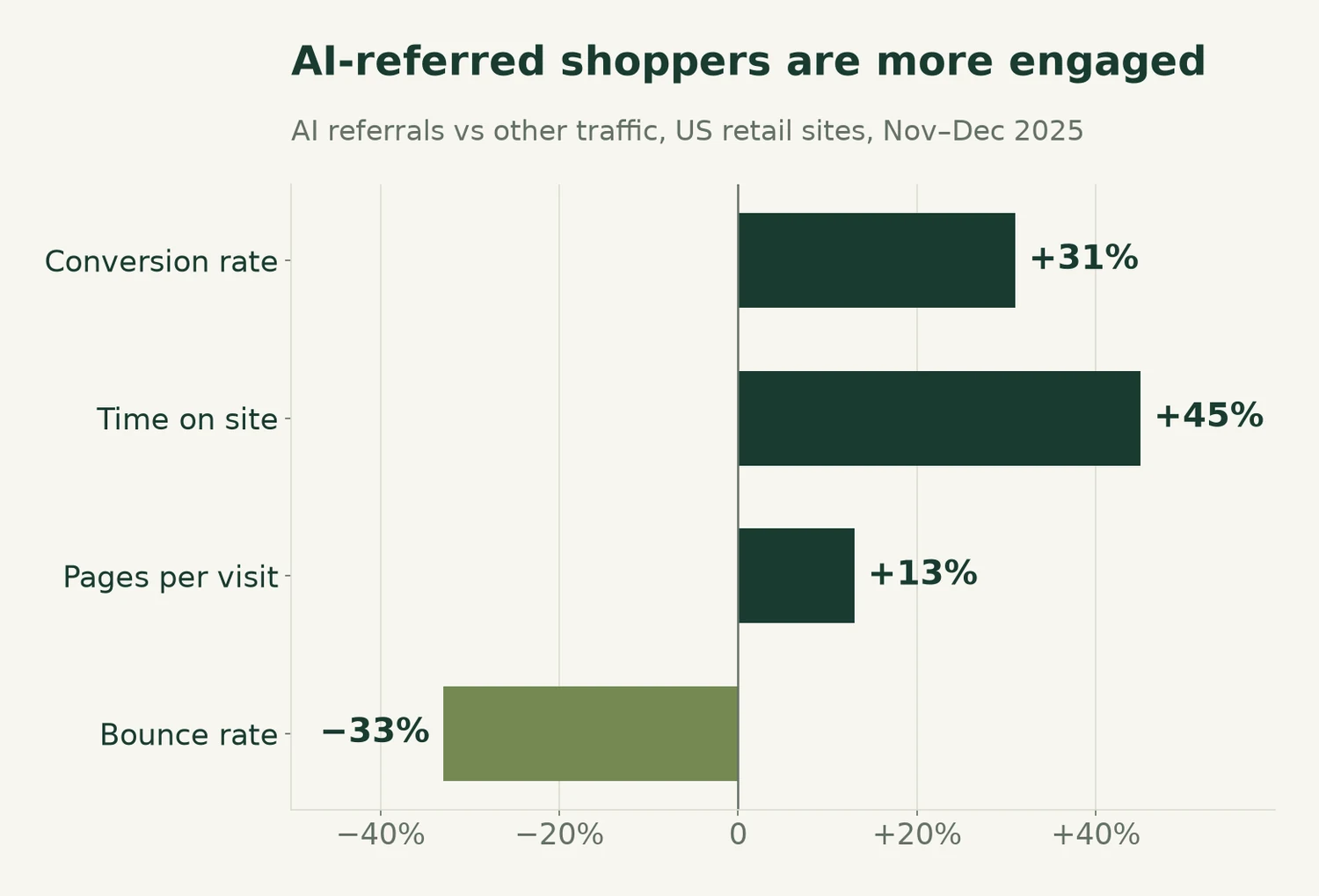
Why does this matter commercially? Visitors who arrive from an assistant have usually done their research already. Adobe’s US data for the 2025 holiday season found that AI-referred visitors converted 31% better than other traffic, spent 45% more time on site and were 33% less likely to leave straight away. Adobe’s UK commentary makes the same point: by the time a shopper clicks through from ChatGPT or Gemini they are often in “buy mode”, so long registration forms or extra checkout steps can lose the sale. UK results will vary by sector, so measure your own before relying on these figures.
Platform notes: Magento 2, Shopify and WooCommerce
The principles are the same on every platform, but each one has its own common gaps.
Magento 2 and Adobe Commerce
- Configurable products. Check whether your feed and structured data describe the parent product or the specific child SKU. A shopper asking for “men’s size 9, wide fit, blue” needs the variant’s own price, stock, image and identifiers.
- Layered navigation and canonicals. Filters can create many URLs for the same item. Make sure each product has one indexable canonical URL that appears in your sitemap and feed.
- Structured data. Default themes output only basic product markup. Check what your theme or extensions produce and make sure it includes price, currency, availability, identifiers, shipping and returns, and that it matches the visible page.
- Speed and stability. Heavy front ends slow down both shoppers and crawlers. A lighter theme such as Hyvä, good caching and a supported, patched Magento version all help.
Shopify
- Know your Shopify Catalog status. If you sell to US customers, Shopify Catalog can supply your products to ChatGPT and Copilot automatically. You can manage AI channels in the Shopify admin. UK-only stores still rely on crawling, feeds and good product pages.
- Variant URLs and data. Check that each
?variant=URL selects the right option and image, and that your feed app and theme agree on price and stock. - Policies and disclosures. Shopify requires completed terms of service, privacy and refund policies for the ChatGPT channel. It also asks merchants to put relevant legal disclosures in the first 6,000 characters of product descriptions.
WooCommerce
- Feeds. Use a reliable feed to Google Merchant Center and Microsoft Merchant Center, and schedule frequent updates for price and stock.
- Plugins and bot rules. Security, caching and CDN tools can block unfamiliar crawlers. Check that OAI-SearchBot, Googlebot and Bingbot can reach your product pages.
- Markup conflicts. WooCommerce, the theme and SEO plugins can all output product markup. Make sure there is one complete, accurate set.

The 12-step AI shopping readiness checklist
Work through these in order. The first six steps fix the foundations that every channel depends on, including Google Shopping and marketplaces, so the effort is not wasted if AI referrals grow slowly.
- Let the right crawlers inCheck robots.txt and your CDN, firewall or bot-protection settings for Googlebot, Bingbot and OAI-SearchBot. OpenAI treats OAI-SearchBot (search) and GPTBot (model training) separately, so you can allow one and block the other.
- Give every sellable variant a stable identityUse a unique, unchanging ID per variant, plus brand, GTIN or manufacturer part number where they exist. Never reuse an ID for a different product.
- Write titles that answer the question“Trail 502” tells a shopper very little. “Trail 502 men’s waterproof trail running shoe, wide fit, blue” matches real requests, as long as every detail is accurate.
- Fill in the attributes shoppers filter onDimensions, material, colour, finish, compatibility, coverage, care and limitations. Look through customer-service emails and chat logs for questions you keep answering by hand, and add those answers to the product data.
- Show the full price clearlyShow the price of the exact variant in GBP, including VAT and any unavoidable charges. Add unit pricing, such as price per item on multipacks, where it helps comparison, and keep sale prices accurate.
- Publish delivery and returns factsState delivery costs, lead times, postcode restrictions and your returns window on the product page and in your feeds. “Delivered this week” is a common requirement in AI prompts.
- Keep feeds and pages in syncPrice, stock and images should match across Google Merchant Center, Microsoft Merchant Center, your structured data and the visible page. Mismatches can lead to disapprovals and stale answers.
- Validate structured dataUse
ProductandOffermarkup, plus shipping and return details where supported, and test with Google’s Rich Results Test. The markup must match what the page shows. - Collect and show genuine reviewsAssistants summarise reviews from across the web. Encourage honest reviews, reply to problems and never publish fake or incentivised reviews without disclosure.
- Publish genuinely useful buying contentWrite comparison guides, sizing and compatibility charts, and FAQs based on real customer questions. These give assistants something specific to cite, and they help human shoppers too.
- Make the landing experience fast, especially on mobileAdobe found that 61.5% of UK online holiday spend in 2025 happened on mobile. Speed up product pages, allow guest checkout and remove unnecessary steps.
- Claim your profiles and measureClaim your business in ChatGPT’s Business Hub, keep your Google Business Profile and Merchant Center accounts healthy, and set up the measurement described below.
What about llms.txt?llms.txt is a proposed file that gives language models a Markdown summary of a site. It is cheap to add, but it is a proposal, not a standard, and Google says you do not need AI text files to appear in its AI features. Do it after the steps above, not instead of them.
A product record, before and after
Here is the same running shoe described twice. The “after” version answers the trail runner’s brief without anyone having to guess. Every value must be true for your product, so do not copy these numbers.
| Field | Before | After |
|---|---|---|
| Title | Trail 502 | Trail 502 men’s waterproof trail running shoe, wide fit, blue |
| Price | “From £99” (only some sizes) | £124.99 inc. VAT for the exact size, width and colour shown |
| Suitability | Not stated | Waterproof membrane; 5 mm lugs for mud and wet trails; 310 g per shoe (UK 9); standard and wide fits; UK sizes 6–13 |
| Identifiers | SKU only | Stable variant ID, brand, GTIN, manufacturer part number |
| Delivery | Shown at checkout | Mainland UK delivery in 2–4 working days; postcode checker on the page |
| Returns | Link in the footer | 30-day returns on unworn shoes; policy linked from the product page and feed |
| Images | One side-on shot | Side, sole, top and heel views plus an on-foot shot for the exact colour |
Run a quick “shortlist test” on ten important products. Give someone who does not know the range the shopper’s brief and the product page, then the feed row. Ask whether they can confirm the product fits the brief. Wherever they hesitate, an AI assistant is likely to hesitate too. Fix the gap in the system that owns the field, whether that is your PIM, ERP, Magento attributes or Shopify metafields, so that it stays fixed in the next export.

How to measure AI shopping traffic and visibility
AI visibility is harder to measure than search rankings because answers change by wording, location and user. Combine three views.
1. Referral traffic in GA4
Create a custom channel group or segment for AI assistants, using session source rules such as chatgpt.com, perplexity.ai, copilot.microsoft.com and gemini.google.com. Links from ChatGPT are often tagged with utm_source=chatgpt.com, so include that in your rules too. Compare engagement, add-to-basket rate, conversion rate and revenue per session with your other channels, by landing page. Some AI visits arrive with no referrer and show up as direct traffic, so treat this segment as a minimum.
2. Search Console and Bing Webmaster Tools
Google counts clicks and impressions from AI Overviews and AI Mode in the Search Console Performance report, under the “Web” search type. They are not shown as a separate line, so watch your product and category pages for changes in queries, impressions and click-through rate.
3. A monthly prompt panel
Write 10 to 20 prompts based on how your customers actually ask, such as “best waterproof trail running shoes under £130 with UK next-day delivery”. Run them monthly in ChatGPT, Google AI Mode, Copilot and Perplexity, from a UK location. Record whether you appear, which product and price is shown, which sources are cited and whether the facts are right. BCG suggests tracking “share of model”, position, citations, sentiment and referral traffic. If an answer shows an old price or a discontinued product, fix the data before you blame the algorithm.

UK rules to keep in mind
AI changes how customers find you, but it does not change your obligations to them.
- Prices must be complete. Under the Digital Markets, Competition and Consumers Act 2024, rules in force since 6 April 2025 ban drip pricing. Unavoidable fees must be included in the headline price, and that applies to the prices you feed to any channel.
- Reviews must be genuine. The same rules ban fake reviews and concealed incentivised reviews. Businesses that publish reviews must take reasonable steps to prevent and remove them.
- You are responsible for your own AI agents. If you add an AI shopping assistant or customer-service chatbot to your site, the CMA’s guidance says you are responsible for what it does in the same way you are for an employee, even if a third party built it. Label it clearly, train and test it on your returns and cancellation rules, and keep a human reviewing its answers. Breaches can lead to fines of up to 10% of worldwide turnover.
Frequently asked questions
Can UK shoppers buy directly inside ChatGPT?
Not at the moment. OpenAI’s Instant Checkout launched only for US users, and since March 2026 OpenAI has let merchants use their own checkouts. UK shoppers use ChatGPT to research and compare products, then buy on the retailer’s website.
Do I need a special feed or schema to appear in AI answers?
For Google, no. Google says there are no extra requirements and no special schema for AI Overviews or AI Mode, although standard Product and Offer markup and an accurate Merchant Center feed still help. For ChatGPT, UK retailers mainly rely on crawlable pages and third-party product data. OpenAI’s standard direct feed upload currently targets the US.
Should I block AI crawlers?
That is a business decision. OpenAI uses separate crawlers for search (OAI-SearchBot) and for model training (GPTBot), so you can allow search visibility while opting out of training. If you block OAI-SearchBot, OpenAI says your site will not be shown in ChatGPT search answers.
Is my Shopify store already in ChatGPT?
Possibly. Shopify Catalog shares eligible products with ChatGPT, but Shopify’s help centre says the ChatGPT channel requires your store to sell to customers in the United States. Check the agentic storefront settings in your Shopify admin.
How long does it take to see results?
Crawling and feed changes can be picked up within days. OpenAI says robots.txt changes take about 24 hours to apply to search results. Answers vary and change over time, so judge progress by monthly prompt checks and referral trends over a quarter, not by one answer.
Is AI shopping worth prioritising over Google Shopping?
Treat them as the same project. Accurate titles, attributes, prices, stock, delivery and reviews improve Google Shopping, Microsoft Shopping, marketplaces and AI assistants together. AI referrals are still a small share of traffic for most retailers, so do not neglect the channels that already bring in revenue.
Sources
Figures were checked against these sources in November 2026. AI shopping features change quickly, so check the latest documentation before you make technical changes.
- Ofcom, The Era of Answer Engines discussion paper (Ipsos iris data, June 2024 to June 2025)
- Ofcom, Online Nation 2025
- Adobe Digital Insights, UK online spending, holiday and full year 2025 (January 2026)
- Adobe Digital Insights, AI-driven traffic across industries, US holiday 2025 (January 2026)
- Office for National Statistics, internet sales as a percentage of total retail sales (J4MC)
- BCG, AI Agents Will Reshape E-Commerce. European Players Must Prepare Now (December 2025)
- Barclays, One in three Brits use AI to budget smarter (August 2025)
- OpenAI, Powering Product Discovery in ChatGPT (March 2026)
- OpenAI, Buy it in ChatGPT: Instant Checkout and the Agentic Commerce Protocol (September 2025)
- OpenAI, Introducing Businesses in ChatGPT
- OpenAI Help Centre, Shopping with ChatGPT Search
- OpenAI developer docs, Submit product feeds
- OpenAI developer docs, Product feed schema
- OpenAI developer docs, Overview of OpenAI crawlers
- Agentic Commerce Protocol specification (GitHub)
- Shopify Help Centre, Selling on ChatGPT
- Google, AI Mode now available on Google Search in the UK (July 2025)
- Google Search Central, AI features and your website
- Google Merchant Center Help, About the Universal Commerce Protocol (UCP)
- Google, shopping updates from Google Marketing Live (May 2026)
- Google Search Central, merchant listing structured data
- Microsoft Advertising, Copilot Checkout and Brand Agents (January 2026)
- Perplexity, Shopping That Puts You First (November 2025)
- GOV.UK, Fake reviews and sneaky hidden fees banned once and for all
- CMA, Complying with consumer law when using AI agents
- llms.txt proposal
Not sure how your catalogue looks to an AI assistant? Try the free AI visibility checker, or email hello@palmultimedia.com for a review of your product data, feeds and tracking.
Talk to Raspal about AI shopping ↗