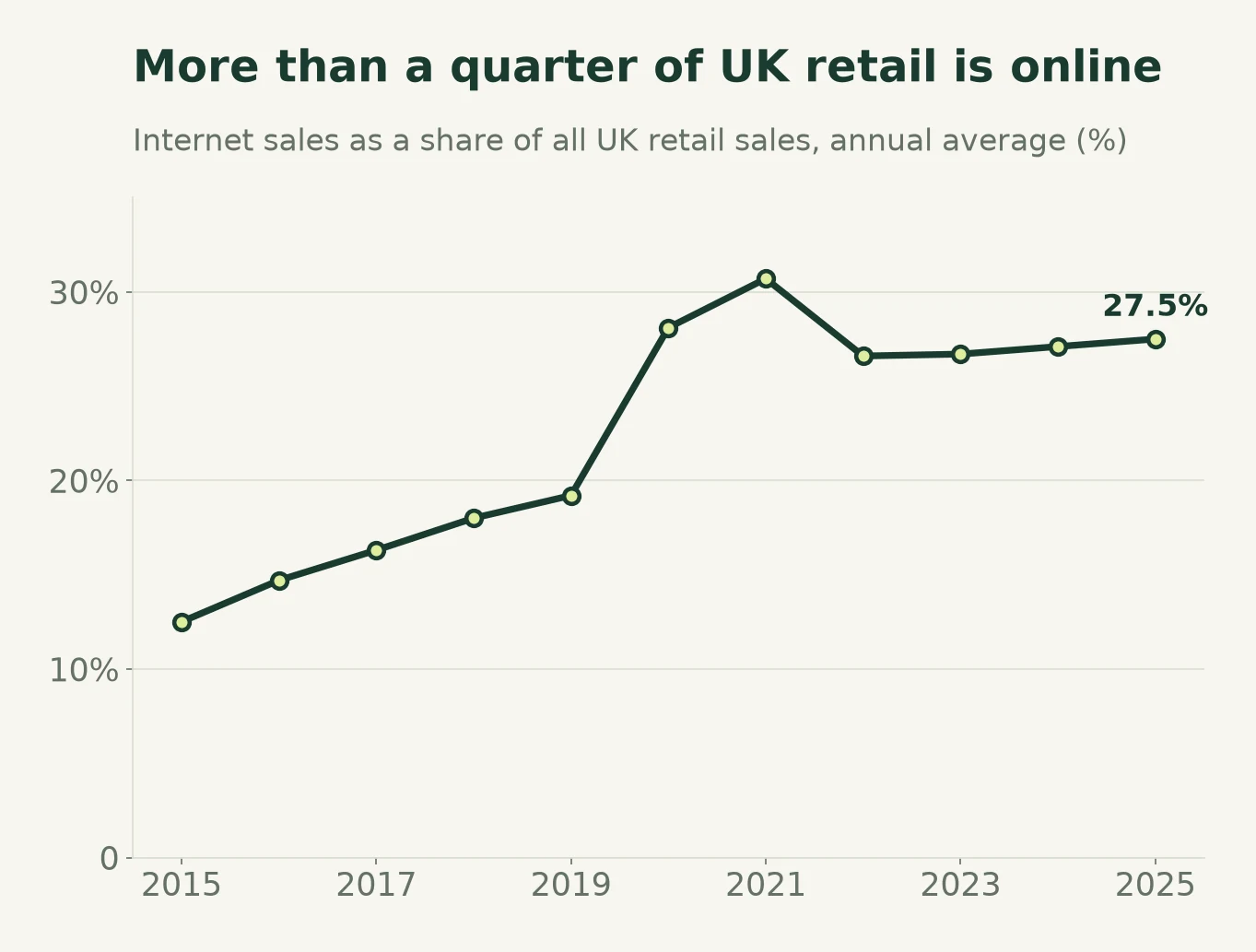
- Online sales were 27.5% of UK retail in 2025, and Google handled 90.6% of UK searches in October 2026.
- Shopping or Performance Max for products, plus Search for brand and key categories, is the usual starting point.
- Tracking, feed quality, landing pages and margin come before any bidding strategy.
- Work out your break-even cost per click from profit per order and conversion rate.
- Give new accounts a structured 90 days: set up, learn, refine, then scale.
Why Google Ads still matters for online shops
More than a quarter of UK retail sales now happen online, and most product searches start on Google. Google Ads lets you appear at the moment someone searches for what you sell, and pay only when they click. Done well, it is one of the most measurable ways to grow an ecommerce business. Done badly, it is one of the quickest ways to spend money.
 Google Ads
 Search

 Advertising
Logos are trademarks of their respective owners and are shown for identification only. No partnership or endorsement is implied.
Where your customers search
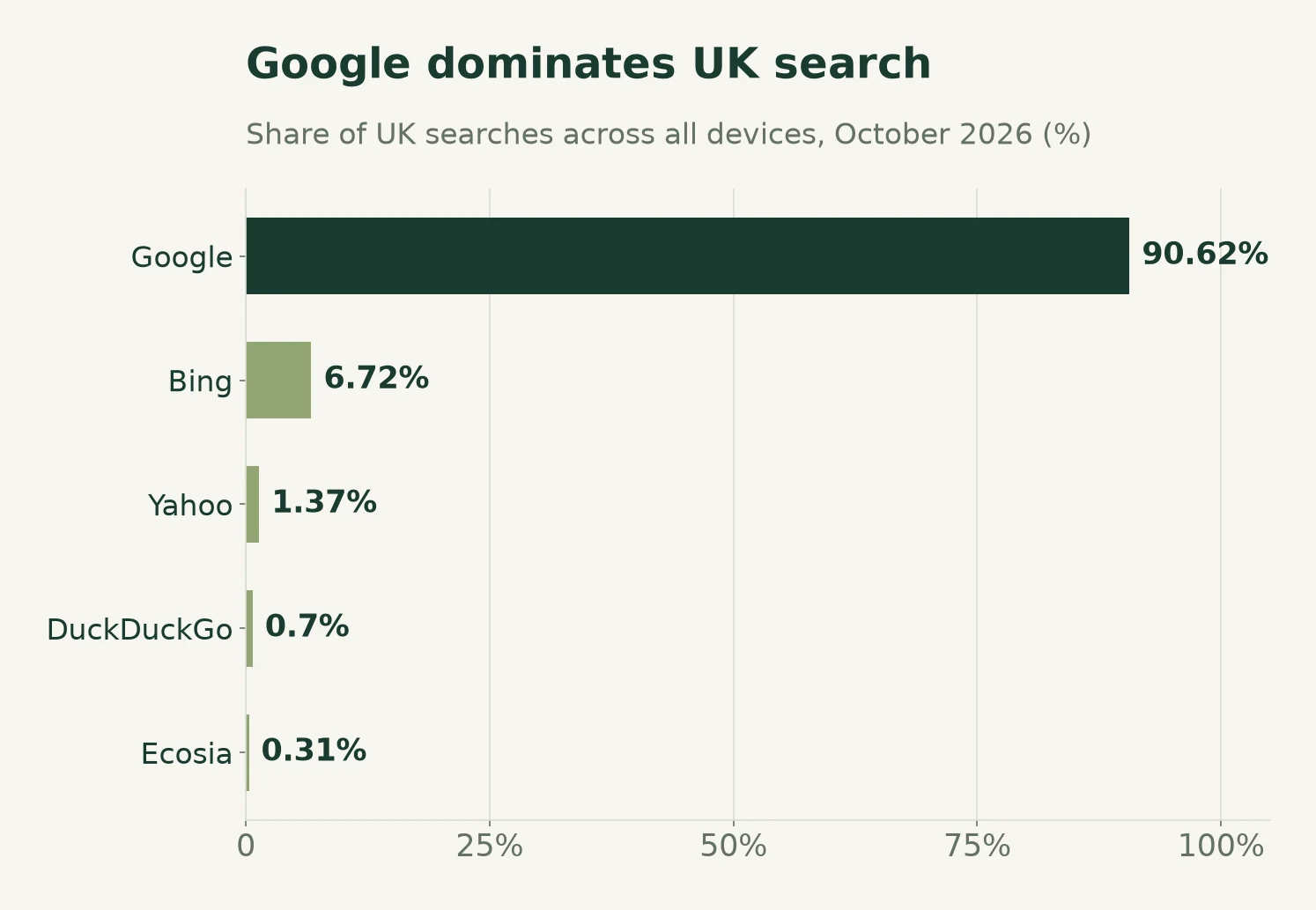
Google takes the vast majority of UK searches, so it is the natural place to start. Microsoft Advertising, which also serves ads on Yahoo, DuckDuckGo and Ecosia, is worth testing once Google is profitable, especially if many of your customers buy on desktop.
The campaign types that matter for ecommerce
| Campaign type | What it does | Best for |
|---|---|---|
| Shopping | Product ads with image, price and shop name, from your feed | Selling specific products |
| Performance Max | One campaign across Search, Shopping, YouTube, Display and more | Scaling with good data and a clear brief |
| Search | Text ads on Google results, now with optional AI Max | Category, brand and high-intent queries |
| Demand Gen | Visual ads on YouTube, Discover and Gmail | Building demand and remarketing |
| Brand | Search ads for your own brand terms | Protecting brand traffic from competitors |
Most shops start with Shopping or Performance Max for products, plus a Search campaign for brand and key categories. Add more only when the basics are profitable.

Get the foundations right first
The four foundations. Without them, automated bidding optimises towards the wrong thing.
Conversion tracking
Track purchases with their real values, set up enhanced conversions, and check that reported conversions match your orders. Smart Bidding is only as good as the data you give it.
Product feed
Your feed is your Shopping ad. Follow Google’s product data specification: clear titles with brand, product type and key attributes; good images; accurate prices and stock; and GTINs where products have them.
Landing pages
Ads send people to product and category pages, so those pages must load fast, show price, delivery and returns clearly, and make it easy to buy. Baymard’s research puts average basket abandonment at 70.22%; much of it is fixable.
What “good” looks like
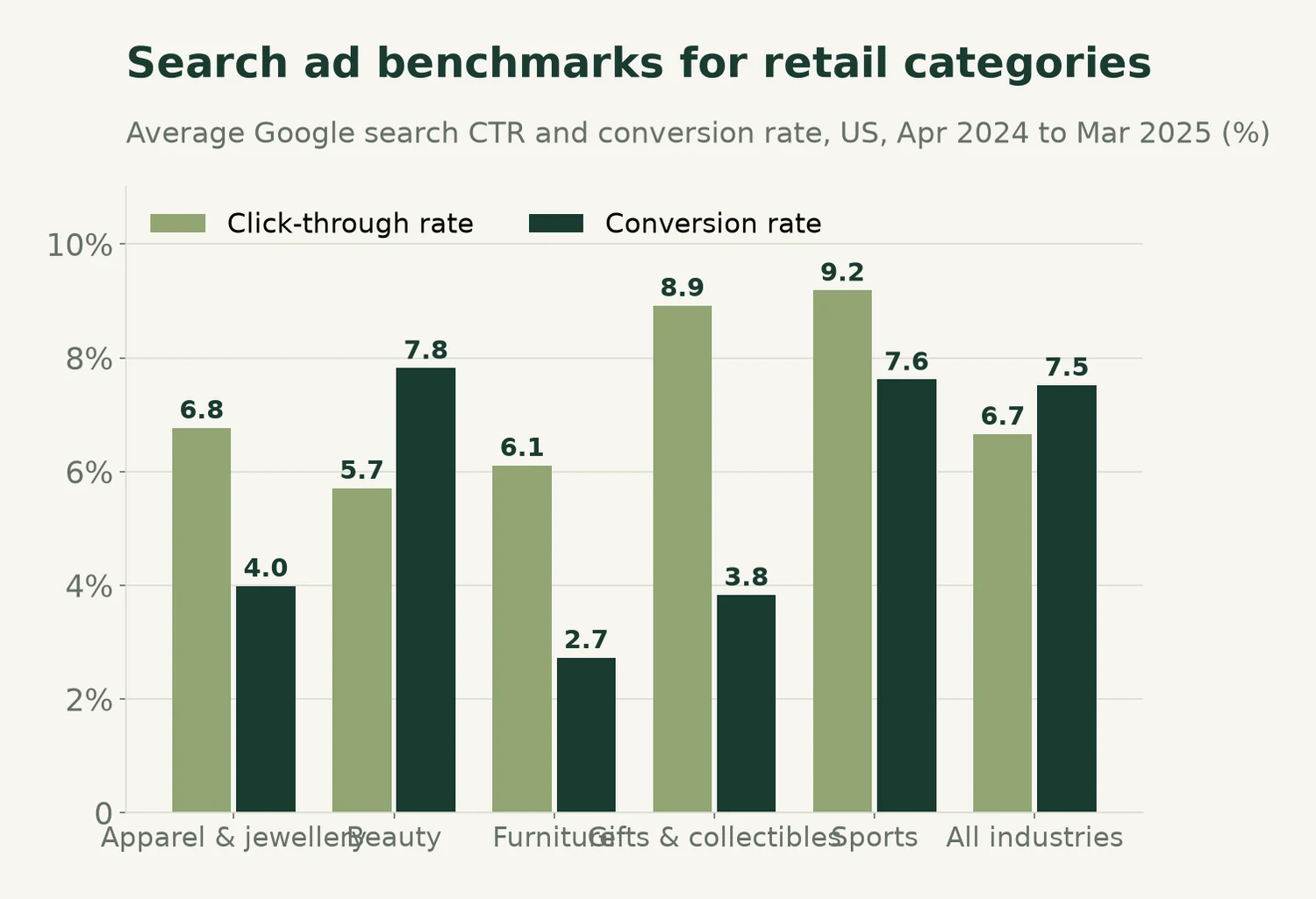
Benchmarks give context, not targets. Your own break-even point matters more: divide your profit per order by your conversion rate to find the most you can afford to pay per click.
A simple sum. If an average order earns £30 profit before advertising and 3% of visitors buy, you can afford up to £0.90 per click to break even (£30 × 0.03). Bid below that to make money, or above it only if repeat purchases justify it.
Your first 90 days
- Weeks 1–2: set upTracking, Merchant Center, feed fixes, and a simple account with brand, Shopping or Performance Max, and one category Search campaign.
- Weeks 3–6: learnLet bidding gather data. Review search terms weekly and add negatives. Fix feed disapprovals.
- Weeks 7–10: refineSplit products by margin with custom labels. Set return targets. Replace weak ads and images.
- Weeks 11–13: scaleIncrease budget on what is profitable. Test Microsoft Advertising or Demand Gen if the core is working.
Frequently asked questions
How much should a small online shop spend on Google Ads?
Start with a budget you can afford to test for at least six to eight weeks, focused on your best products. Work out your break-even cost per click from margin and conversion rate, then scale what is profitable.
Is Shopping or Performance Max better?
Performance Max reaches more channels and is Google’s main recommendation. Standard Shopping gives tighter control. Many shops use Performance Max with good feed labels, and keep Shopping for specific tests.
Do I need a Google Merchant Center account?
Yes, for Shopping and product ads in Performance Max. Merchant Center holds your product feed and checks it against Google’s policies.
How long until Google Ads is profitable?
Expect a learning period of several weeks while bidding gathers data. Accounts with good tracking, a clean feed and competitive prices usually find their level faster.
Should I hire an agency or a consultant?
Choose someone who reports on profit, explains changes and gives you ownership of the account and data, whoever they are.
Sources
Figures and product details were checked against these sources in November 2026. Platforms change quickly, so check the latest documentation before making technical or budget decisions.
- Office for National Statistics, Internet sales as a percentage of total retail sales (J4MC)
- Statcounter, UK search engine market share
- IAB UK, Digital Adspend 2025
- WordStream by LocaliQ, Google Ads Benchmarks 2025
- Google Ads Help, About Performance Max campaigns
- Google, Introducing AI Max for Search campaigns
- Google Ads Help, About enhanced conversions
- Google Merchant Center Help, Product data specification
- Google Ads Help, About Smart Bidding
- Baymard Institute, Cart abandonment rate
- Microsoft Learn, Microsoft Advertising Network
Want a second opinion on your own store? Email hello@palmultimedia.com or send a message with your website address and the problem you are trying to solve.